Your mind can grow stronger with practice, and your faith can help you meet every new challenge with patience, wisdom, and hope.
On a quiet Tuesday morning, a father sits at his kitchen table, staring at a puzzle his daughter brought home from school. He has spent weeks feeling distracted by work, worried about bills, and frustrated because he keeps forgetting little things. When his daughter asks him to help, he almost says no. Instead, he puts down his phone and tries. They laugh over their mistakes, and for a few minutes, his mind feels awake again.
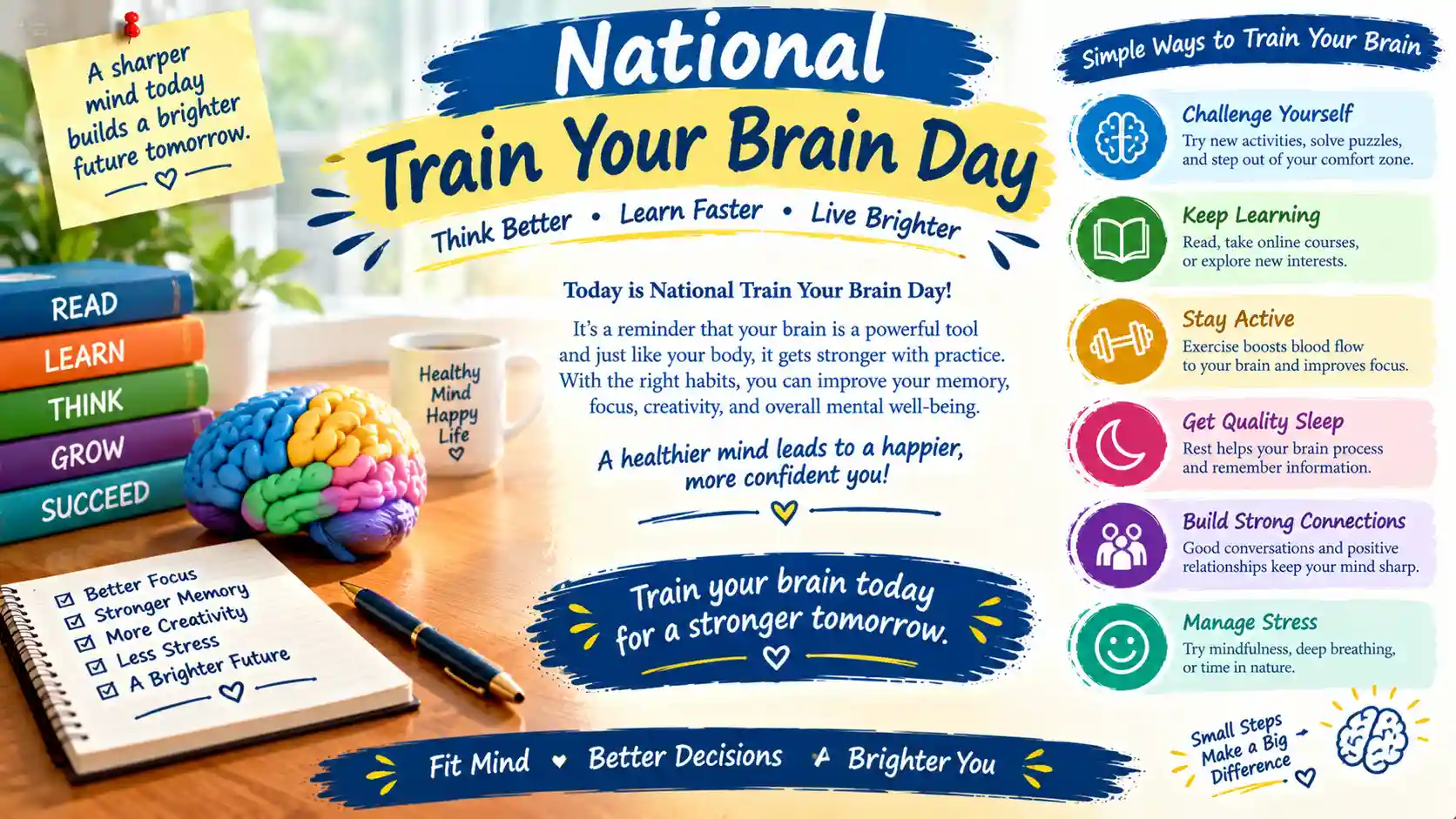
This small moment reflects the spirit of National Train Your Brain Day, observed on October 13. It encourages people to challenge their minds, practice new skills, and develop habits that support mental sharpness. For Christians, it can also be a reminder to seek God’s wisdom while caring for the minds He has given us.
Proverbs 2:6 says, “For the LORD giveth wisdom: out of his mouth cometh knowledge and understanding” (KJV).
Our minds need attention, just as our hearts need encouragement. Prayer is the turning point that helps us bring our thoughts, struggles, and desire to learn before God.
What Is National Train Your Brain Day?
National Train Your Brain Day is an observance that encourages people to exercise their minds through activities such as reading, solving puzzles, learning languages, practicing memory skills, and exploring unfamiliar subjects. It reminds us that learning does not have to end when school finishes or adulthood begins. Every day offers opportunities to discover something new.
The observance also invites us to consider our mental habits. Are we giving ourselves time to think deeply, or are we constantly distracted by notifications, worries, and endless scrolling? Are we willing to make mistakes while learning, or do we avoid challenges because we fear looking foolish?
For believers, caring for the mind can become part of a thoughtful spiritual life. Prayer does not replace practical learning, rest, or professional care when needed. Instead, it can help us approach these things with humility and purpose. We can ask God for wisdom, discipline, patience, and the courage to keep learning when progress feels slow.
If you are a student, parent, teacher, older adult, or someone rebuilding confidence after a difficult season, this day offers a meaningful opportunity to begin again.
15 Prayers to Exercise Your Mind and Grow in Wisdom
Sometimes the hardest part of learning is not understanding something new. It is finding the patience to try again after getting it wrong. These prayers connect mental growth with faith, helping you approach each challenge with a teachable heart.
Prayers for Focus, Discipline, and Learning
1. Emotion: Desperation Prayer for a Distracted Mind
Lord, my thoughts feel scattered, and I struggle to finish what I begin. Please help me slow down, set aside unnecessary distractions, and give my attention to what matters today. Teach me to take one small step instead of feeling defeated by everything at once. Amen.
2. Emotion: Gratitude Prayer for the Gift of Understanding
Father, thank You for the ability to learn, question, discover, and grow. Help me appreciate the knowledge I already have without becoming proud of it. May every new skill remind me to be grateful and use what I learn to serve others. Amen.
3. Emotion: Surrender Prayer When Learning Feels Difficult
God, I surrender my fear of making mistakes and my desire to understand everything immediately. Give me patience when an answer does not come easily. Help me accept that growth takes time and trust You while I keep doing my part. Amen.
4. Emotion: Boldness Prayer for Courage to Try Something New
Heavenly Father, give me the courage to explore unfamiliar ideas and develop abilities I have neglected. Keep embarrassment from becoming a wall around my potential. Help me ask questions, welcome correction, and keep learning even when I feel like a beginner. Amen.
Prayers for Memory, Wisdom, and Clear Thinking
5. Emotion: Grief Prayer for Mental Confidence After a Hard Season
Lord, difficult seasons have left me feeling unlike myself, and sometimes my thoughts seem heavier than they used to be. Meet me with compassion as I rebuild my confidence. Help me seek the support I need, respect my limits, and remember that my worth is greater than my performance. Amen.
6. Emotion: Hope Prayer for Lifelong Learning
God of hope, reminds me that there is still room for discovery in my life. If I am learning a language, reading Scripture, or developing a practical skill, help me stay curious. Let today’s effort become the beginning of a more thoughtful tomorrow. Amen.
7. Emotion: Intercession Prayer for Students and Teachers
Father, bless students who struggle to understand their lessons and teachers who patiently guide them. Give learners access to encouragement, helpful resources, and opportunities to ask questions without shame. Strengthen educators as they nurture curiosity, critical thinking, and kindness in their classrooms. Amen.
8. Emotion: Awe Prayer for Wonder and Discovery
Creator God, the world is filled with questions that invite us to look closer. Give me eyes to notice its beauty and a heart willing to explore what I do not yet understand. May discovery lead me toward humility rather than arrogance, and gratitude rather than pride. Amen.
Prayers for Emotional Balance and Mental Strength
9. Emotion: Confession Prayer for Unhelpful Mental Habits
Lord, I confess that I sometimes waste my attention on distractions and feed thoughts that leave me discouraged. Help me recognize habits that are not serving me well. Give me the honesty to make changes without condemning myself for yesterday’s mistakes. Amen.
10. Emotion: Trust Prayer for Clear Decisions
Faithful God, when choices feel complicated, help me gather the right information and think carefully before acting. Keep fear and impatience from controlling my decisions. Guide me toward wise counsel and remind me that I can seek Your direction while using the understanding I have gained. Amen.
Prayers for Peace, Courage, and Renewed Purpose
11. Emotion: Longing Prayer for a Teachable Heart
Father, I long to become wiser, kinder, and more thoughtful in the way I live. Remove the pride that makes me resist correction and the insecurity that makes me afraid of learning. Help me listen with an open heart and grow through the experiences You place before me. Amen.
12. Emotion: Peace Prayer for Relief From Overthinking
God, my mind sometimes turns small concerns into overwhelming problems. Help me distinguish what needs my attention from what I cannot control. Teach me to breathe, pause, pray, and return to the present moment without demanding that every uncertainty disappear. Amen.
13. Emotion: Courage Prayer for Starting Again
Lord, I have stopped learning things before because I thought I was too late or too far behind. Give me the courage to begin again without comparing my progress to someone else’s. Help me celebrate honest effort and keep moving when improvement comes slowly. Amen.
14. Emotion: Healing Prayer for Mental Well-Being
Merciful Father, bring comfort to those carrying emotional exhaustion, grief, or persistent worry. Help them find rest, understanding, and appropriate support. Remind us that caring for our minds is not a failure of faith, and give us the strength to take the next healthy step. Amen.
15. Emotion: Wonder Prayer for a Renewed Mind
Lord, awaken my curiosity and help me see ordinary days as opportunities to grow. Give me the discipline to practice, the humility to learn, and the wisdom to apply knowledge with love. May my mind become a place where thoughtful questions lead to meaningful action. Amen.
Why National Train Your Brain Day Can Transform Your Life
A young student may begin the day convinced that mathematics is simply beyond her ability. She gets an answer wrong, feels embarrassed, and wants to close her notebook. But a patient teacher helps her work through the problem one step at a time. Eventually, she understands it not because she became perfect overnight, but because she kept practicing.
Small experiences like this show why mental exercise matters. Reading, solving puzzles, learning new skills, and having thoughtful conversations can challenge us to think in different ways. These activities do not guarantee protection against cognitive decline, but they can make learning a meaningful part of daily life.
Romans 12:2 teaches believers to be transformed by the renewing of their minds. This verse encourages a deeper kind of growth: examining our attitudes, becoming more discerning, and allowing God’s truth to shape how we live.
The goal is not to know everything. It is to remain willing to learn.
15 Ways to Strengthen Your Mind and Faith
These practical ideas can help you celebrate the occasion without spending money or making your day complicated.
- For better focus: Read a few pages of a book without checking your phone.
- For stronger vocabulary: Learn three unfamiliar words and use them in sentences.
- For memory practice: Recall the main points of something you learned yesterday.
- For problem-solving: Try a crossword, Sudoku puzzle, or logic riddle.
- For spiritual understanding: Read a short Bible passage and reflect on its meaning.
- For creative thinking: Write a short story using five unrelated words.
- For patience: Work through a difficult puzzle without immediately looking up the answer.
- For curiosity: Research a topic you have always wanted to understand.
- For communication: Have a thoughtful conversation and listen without interrupting.
- For mental flexibility: Try a different route on a familiar walk, where safe.
- For practical skills: Learn a new recipe, craft, or computer shortcut.
- For reflection: Write down one mistake and what it taught you.
- For attention: Complete one small task before moving to another.
- For connection: Play a word game with a family member or friend.
- For balance: Take a break, move your body, and give yourself enough sleep.
These activities are opportunities to engage your mind, not tests of your worth. Choose what suits your age, abilities, interests, and circumstances.
Training Your Mind for Protection and Peace
Mental strength is not about controlling every thought or never experiencing fear. It is about learning to respond thoughtfully when life becomes difficult. Prayer, healthy routines, and support from trusted people can help you develop a steadier approach to everyday challenges.
Protecting Your Attention From Distractions
Your attention is valuable. Constant notifications, endless scrolling, and multitasking can make it harder to give meaningful work the concentration it deserves.
Try these four protective habits:
- Silence unnecessary notifications during study or work.
- Keep your phone away when reading or solving puzzles.
- Set reasonable boundaries around social media.
- Pause before reacting to upsetting information online.
Finding Peace When Your Thoughts Feel Overwhelming
A peaceful mind is not a mind that never struggles. It is a mind that has opportunities to rest, reflect, and receive support.
Three habits worth practicing are:
- Write down worries so you can identify which ones need action.
- Take slow, comfortable breaths when you feel overwhelmed.
- Speak with someone trustworthy when your concerns become difficult to manage alone.
Philippians 4:8 encourages believers to direct their thoughts toward things that are true, honorable, just, pure, lovely, and worthy of praise. This is not a command to deny painful experiences. It is an invitation to make room for what is good and truthful alongside life’s difficulties.
Building Mental Strength in Specific Situations
Your mind faces different challenges depending on the season of life you are experiencing. A student may worry about exams, a parent may struggle with competing responsibilities, and an older adult may feel frustrated when recalling information takes longer than expected.
💼 When Work Requires Concentration
Break a large assignment into smaller tasks. Work on one task at a time, take short breaks, and ask for clarification when instructions are unclear. Consistent effort is more useful than repeatedly criticizing yourself for losing focus.
💔 When Emotional Pain Makes Thinking Difficult
Give yourself room to process grief, disappointment, or relationship struggles. Journaling, talking with a trusted person, and maintaining simple routines can help. If emotional distress persists or interferes with daily life, consider seeking professional support.
🏥 When You Are Concerned About Your Memory
Occasionally forgetting a name or misplacing an item happens to many people. However, persistent or worsening memory problems deserve attention from a healthcare professional, especially when they affect everyday activities. Brain games are not a substitute for medical assessment.
👨👩👧 When You Want to Help Your Family Learn
Make curiosity part of family life. Ask children open-ended questions, solve puzzles together, share interesting facts at dinner, or read a story aloud. Encourage effort and questions instead of expecting every answer to be correct.
📖 When You Want to Understand Scripture More Deeply
Read a short Bible passage, look at its surrounding context, and write down what it teaches about God, wisdom, or daily life. Compare your first impression with the passage itself, and consult a trusted Bible teacher when you need clarification.
What Changes When Mental Exercise Becomes a Habit
Imagine someone who spends every evening scrolling through a phone because work has left little energy for anything else. One week, that person decides to replace ten minutes of scrolling with reading and a small puzzle. At first, the habit feels unfamiliar. After a while, those ten minutes become a welcome pause in the day.
The important change is not a dramatic transformation overnight. It is the decision to make space for curiosity and purposeful attention. A manageable routine can also create opportunities for reflection, conversation, and spiritual growth.
Over time, you may discover interests you had overlooked and become more comfortable tackling unfamiliar tasks. Progress will vary, and some days will be harder than others. Consistency matters more than perfection.
How to Make Brain Training a Daily Habit 10 Steps
You do not need expensive apps or complicated equipment to get started. Build a routine that fits your real life.
- Choose a regular time. Set aside 10–15 minutes in the morning or evening for a mental activity.
- Start with a simple puzzle. Try a word search, Sudoku, crossword, or riddle that matches your current ability.
- Read every day. Read a few pages of a book, a reliable article, or a passage of Scripture.
- Learn something unfamiliar. Practice a new English word, explore a historical topic, or try a beginner lesson.
- Practice remembering. After reading, close the book and recall three things you learned.
- Reduce distractions. Put your phone on silent and focus on one activity at a time.
- Ask better questions. Instead of accepting an explanation immediately, ask why it works and how it applies.
- Discuss what you learn. Explain a new idea to a friend or family member in your own words.
- Support your brain’s health. Prioritize sleep, physical activity, balanced meals, and social connection.
- Review your progress weekly. Record what you practiced, what challenged you, and what you want to explore next.
Remember that the purpose is to create a sustainable habit, not another demanding obligation. Adjust the routine whenever your circumstances require it.
Faith Declarations to Strengthen Your Mind
Read these statements slowly and reflect on how you can put each one into practice.
- I am willing to learn from mistakes without allowing them to define me.
- I am growing in patience as I develop new skills.
- I am capable of asking questions when I need help.
- I have the courage to begin learning something unfamiliar.
- I have opportunities to practice wisdom in ordinary situations.
- I have permission to rest when my mind needs a break.
- God is my source of wisdom, and I can seek His guidance.
- God is teaching me to approach others with humility and understanding.
- God is worthy of my trust when the future feels uncertain.
- I am committed to using what I learn with honesty, kindness, and purpose.
These declarations are reminders of the attitudes you want to cultivate, not guarantees that every challenge will disappear.
Quotes to Inspire Daily Mental Growth
Here are ten original quotes you can share on social media, include in a journal, or use as captions for your October observance post.
- “A curious mind finds new doors in familiar places.”
- “Every honest question is an invitation to grow.”
- “You do not need perfect memory to keep learning.”
- “Wisdom begins when pride stops interrupting curiosity.”
- “A small lesson practiced daily can change how you approach tomorrow.”
- “Your mistakes can become teachers when you stop treating them as verdicts.”
- “Faith gives you a reason to seek wisdom, not a reason to stop asking questions.”
- “Rest is not wasted time; sometimes it is what makes tomorrow’s learning possible.”
- “A growing mind stays humble enough to discover what it does not know.”
- “You honor your potential each time you choose progress over embarrassment.”
Common Questions About Brain Training Answered
What date is National Train Your Brain Day?
It is observed annually on October 13. In 2026, it falls on Tuesday, October 13. The observance encourages people to challenge their minds through puzzles, learning, and other mentally engaging activities.
How can I celebrate this day at home?
Read a new book, solve a puzzle, learn a skill, or play a word game with your family. You can also spend a few minutes reflecting on a Bible passage and writing down what you learned.
What are the best activities for training your brain?
Crosswords, Sudoku, reading, learning a language, playing a musical instrument, and solving unfamiliar problems are all useful ways to engage your mind. Choose activities you enjoy and gradually explore new challenges.
Can prayer help me improve my thinking?
Prayer can help you pause, reflect, seek wisdom, and approach difficult situations with greater intentionality. James 1:5 says that those who lack wisdom can ask God for it. Prayer complements practical learning and does not replace medical or psychological care when needed.
Does brain training prevent memory loss?
No specific puzzle, app, or exercise guarantees that memory loss or dementia will be prevented. Mentally stimulating activities can be part of a healthy lifestyle, alongside physical activity, adequate sleep, social engagement, and appropriate healthcare.
How much time should I spend training my brain each day?
Start with 10–15 minutes if that feels manageable. Increase the time if you enjoy it, but remember that regular engagement, variety, and a balanced lifestyle are more important than following a rigid schedule.
Final Thoughts on National Train Your Brain Day
As this October observance approaches, remember that caring for your mind does not require you to become the smartest person in the room. It asks you to remain curious, make thoughtful choices, and give yourself permission to grow.
National Train Your Brain Day offers a practical reminder to step away from distractions, explore something unfamiliar, and strengthen the habits that support learning. For Christians, it can also become a moment to thank God for the ability to discover, reflect, and seek wisdom.
You may not remember every page you read or solve every puzzle correctly. That is perfectly fine. What matters is your willingness to keep showing up, learn from experience, and use your knowledge responsibly.
Proverbs 4:7 says, “Wisdom is the principal thing; therefore get wisdom: and with all thy getting get understanding” (KJV).
Let that truth guide your next step. Learn with humility, think with care, and allow your faith to shape the way you use what you discover.
You do not have to know everything today; you only have to stay willing to learn what tomorrow can teach you.

Ahmad Khan is the founder of Prayerrz.com, a website dedicated to sharing heartfelt prayers, and inspirational content that helps people celebrate special moments and strengthen meaningful connections.