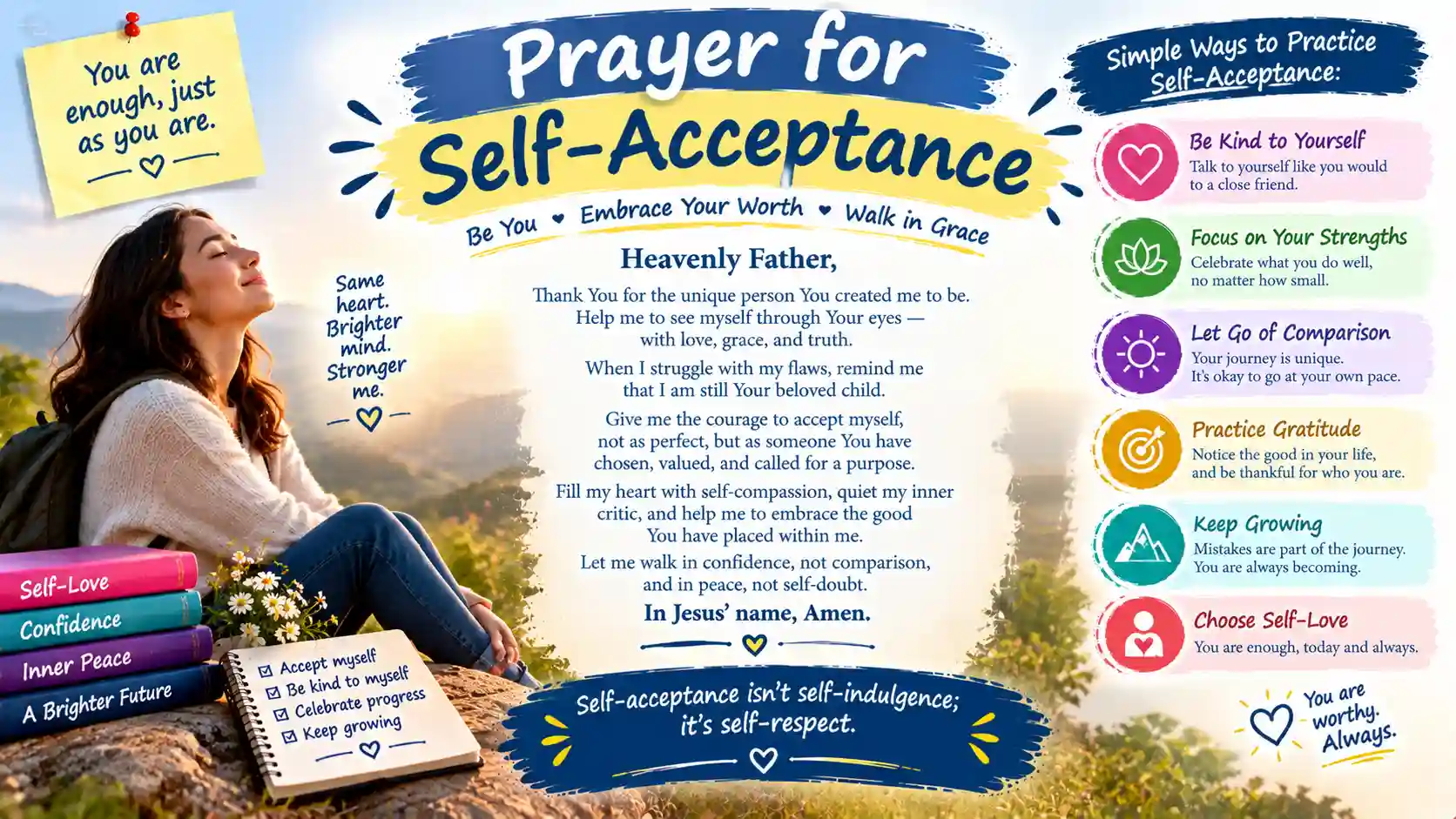
God’s love does not begin when you finally love yourself; you can begin healing because His love is already reaching you.
Emma sat in her car after a family gathering, replaying every conversation in her mind. She worried that she had talked too much, looked tired, and failed to make the right impression. Everyone else seemed confident and comfortable, but she kept finding reasons to criticize herself. Before going home, she whispered a simple prayer, asking God to help her see herself with greater kindness.
Many people know this quiet struggle. You may compare your appearance, personality, achievements, or life journey with others and wonder why you cannot be different. A heartfelt Prayer for Self-Acceptance can help you bring those painful thoughts to God instead of carrying them alone.
Psalm 139:14 says, “I am fearfully and wonderfully made.” This reminds us that our worth is not measured by other people’s opinions or our own harsh judgments.
You do not have to become perfect to begin accepting yourself. Prayer is the turning point that helps you face your struggles with faith, honesty, and grace. Here is how to begin.
What Is a Prayer for Self-Acceptance?
A prayer for self-acceptance is an honest conversation with God about learning to recognize your worth, embrace your individuality, and make peace with the person you are today. It means bringing your insecurities, regrets, weaknesses, and hopes before Him without pretending that everything is fine.
Self-acceptance does not mean believing you never make mistakes or refusing to grow. It means understanding that your mistakes do not define your entire identity. You can acknowledge your weaknesses while still treating yourself with patience and respect.
Spiritually, this journey begins with recognizing that your value is not something you must earn through beauty, success, popularity, or constant approval. God’s grace invites you to approach Him as you are, even when you feel disappointed in yourself.
When you pray about your insecurities, you create space to replace destructive self-talk with truth, humility, and compassion. You begin to understand that personal growth and self-love can exist together. You can work toward becoming a better person without hating the person you are now.
20 Prayers for Self-Acceptance by Purpose
These prayers address different parts of the journey, from confronting insecurity to finding peace in your own story. Choose the one that speaks to your heart today.
Prayers for Releasing Insecurity
1. Emotion: Desperation When You Feel You Are Not Enough
Dear God, I am tired of feeling like I must become someone else to deserve love. Please quiet the voice inside me that says I am never good enough. Help me recognize the value You have given me, even on the days I cannot see it. Teach me to take the next step without tearing myself down.
2. Emotion: Gratitude Thanking God for Your Uniqueness
Father, thank You for creating me with my own personality, gifts, and experiences. Forgive me for overlooking these blessings while wishing I had someone else’s life. Open my eyes to the good within me. Help me appreciate the person I am becoming instead of constantly criticizing the person I am today.
3. Emotion: Surrender Letting Go of Comparison
Lord, I surrender the habit of measuring my life against everyone around me. I cannot see the whole story behind another person’s success, and I do not need to copy their journey. Help me focus on the path You have placed before me. Give me the freedom to grow at my own pace.
4. Emotion: Boldness Accepting Your Appearance
God, give me courage when I look in the mirror and struggle to appreciate what I see. Help me stop treating my appearance as the measure of my worth. Teach me to care for my body with gratitude rather than shame. Let my confidence grow from knowing I deserve dignity, kindness, and respect.
5. Emotion: Grief Making Peace with Your Past
Heavenly Father, I grieve the years I spent believing I was less valuable than others. I wish I had treated myself with more patience and recognized my worth sooner. Help me mourn what hurt without remaining trapped in it. Show me how to move forward with wisdom and compassion for my younger self.
Prayers for Embracing Your Identity
6. Emotion: Hope Believing You Can Grow
Jesus, help me believe that my present struggles do not determine my future. I may not feel confident today, but I can learn to treat myself differently. Give me hope for healthier thoughts, stronger boundaries, and a gentler inner voice. Remind me that meaningful change can happen one small step at a time.
7. Emotion: Intercession Learning to Accept Others
Lord, help me extend to others the patience I am learning to offer myself. When I notice someone’s weaknesses, teach me to respond with understanding instead of judgment. Bless those who struggle with insecurity, loneliness, or rejection. May we create relationships where people can be honest about their imperfections and still feel respected.
8. Emotion: Awe Recognizing God’s Creation
Creator God, I am amazed that every person carries a story no one else can fully understand. Help me see my own life with that same sense of wonder. My personality, experiences, and abilities are part of my unique story. Teach me to appreciate who I am without believing I must be better than anyone else.
9. Emotion: Confession Facing Your Inner Critic
Father, I confess that I sometimes speak to myself in ways I would never speak to someone I love. I focus on my failures and ignore the good I try to do. Forgive my pride when it turns into self-hatred, and help me practice honest, compassionate self-reflection. Teach me to correct my mistakes without attacking my worth.
10. Emotion: Trust Resting in God’s Love
God, when other people’s opinions confuse me, help me return to the truth of Your love. I cannot control every judgment or make everyone understand me. Give me confidence to live according to my values while remaining open to wise correction. Help me trust that rejection does not erase my dignity.
Prayers for Healing Emotional Wounds
11. Emotion: Longing Finding Belonging
Dear Lord, I long to feel accepted without pretending to be someone I am not. Lead me toward people who value honesty, kindness, and mutual respect. Help me stop abandoning my own needs just to keep others happy. Let me experience the comfort of belonging without losing my sense of self.
12. Emotion: Peace Quieting Shame
Merciful God, settle my heart when shame brings back old mistakes or embarrassing memories. Help me remember that I can learn from the past without reliving it every day. Give me a peaceful mind and the patience to challenge unfair thoughts. Let self-compassion become a steady practice in my life.
13. Emotion: Courage Setting Healthy Boundaries
Lord, give me courage to say no when I need to protect my well-being. Help me understand that having boundaries does not make me selfish or unloving. Teach me to speak honestly, respect other people’s needs, and stop seeking approval at the expense of my peace.
14. Emotion: Healing Recovering from Rejection
Father, rejection has sometimes made me question everything about myself. Help me separate painful experiences from the truth of who I am. Give me strength to grieve what I have lost and wisdom to learn from it. Lead me toward relationships where care, honesty, and respect can grow.
15. Emotion: Wonder Discovering Your Gifts
Wonderful Creator, help me notice the gifts I have overlooked because they seem ordinary to me. Show me how my patience, creativity, listening, or determination can bless others. I do not need to possess every talent to have something meaningful to offer. Teach me to use what I have with gratitude.
Prayers for Living with Grace
16. Emotion: Surrender is already used, so this prayer carries humility as its theme: Learning from Mistakes
God, help me admit when I am wrong without deciding that I am a failure. Give me the humility to apologize, make amends, and change my behavior. Remind me that accountability is an expression of growth, not a reason to despise myself. Help me keep learning with an open heart.
17. Emotion: Faithfulness Staying True to Your Values
Lord, help me live honestly, even when pretending would make me more popular. Strengthen my commitment to the values that matter to me. When I feel pressured to change myself to gain approval, remind me that I can listen to others without abandoning my conscience.
18. Emotion: Patience Accepting Your Pace
Father, teach me to be patient with the parts of myself that are still growing. I want to feel confident immediately, but deep change takes time. Help me celebrate small improvements and begin again after difficult days. Let me treat progress as a journey rather than a test I must pass.
19. Emotion: Compassion Speaking Kindly to Yourself
Loving God, help me notice the words I use against myself. When I make a mistake, guide me toward honesty without cruelty. Teach me to offer myself the same patience I would give a struggling friend. May kindness become the language of my inner life.
20. Emotion: Freedom Living Without Constant Approval
God, free me from the exhausting belief that everyone must like me. Help me listen to helpful feedback without allowing every opinion to control my identity. Give me the freedom to make thoughtful choices, accept my limitations, and live with a heart that is secure in Your grace.
Why Self-Acceptance Through Prayer Can Transform Your Life
Imagine someone who spends every evening replaying mistakes from work. At first, their prayers may be little more than a plea to stop feeling inadequate. Over time, those quiet moments can help them recognize harsh thought patterns and respond more thoughtfully.
They might begin apologizing when necessary without calling themselves worthless. They might celebrate a small achievement instead of dismissing it. Prayer does not automatically erase insecurity, but it can help a person approach difficult feelings with patience and spiritual perspective.
Second Corinthians 12:9 reminds believers that God’s grace is sufficient and His power is made perfect in weakness. This encourages us to acknowledge our limitations without believing they make us unworthy of love.
15 Powerful Reminders for Strength and Faith
When negative thoughts return, keep these reminders nearby:
- You can acknowledge a weakness without making it your identity.
- Your appearance does not determine your human worth.
- You are allowed to learn at a different pace from your friends.
- Someone else’s success does not cancel your potential.
- A mistake can become a lesson rather than a lifelong label.
- You can receive constructive criticism without accepting cruelty.
- Your boundaries deserve respect, even when others disagree.
- You do not need universal approval to live a meaningful life.
- Asking for help is a sign of wisdom, not personal failure.
- Your past deserves honest reflection, not endless punishment.
- You can celebrate another person’s beauty without insulting your own.
- Rest is not something you must earn through exhaustion.
- Your personality can be different without being defective.
- You can change a harmful habit while respecting yourself.
- God’s grace invites you to grow without pretending to be perfect.
Self-Acceptance for Protection and Peace
Emotional protection does not mean shutting everyone out. It means learning to guard your sense of worth against constant comparison, disrespect, and destructive self-criticism.
Protecting Your Confidence
- When criticism hurts: Pause before accepting someone’s opinion as the truth about your entire character. Consider if the feedback is fair, useful, and specific.
- When comparison returns: Step away from social media or conversations that repeatedly leave you feeling inferior. Redirect your attention toward your own values and progress.
- When people pressure you: Remember that you can disagree respectfully without proving your worth to everyone.
- When old shame resurfaces: Write down what happened, what you learned, and what you would do differently today. Let the lesson remain without carrying unnecessary punishment.
Finding Peace Within Yourself
- When your mind feels restless: Take a few slow breaths and name the feeling without judging yourself for having it.
- When you feel left behind: Identify one meaningful step you can take today instead of comparing your whole life with someone else’s.
- When you feel imperfect: Remind yourself that acceptance and improvement can happen at the same time.
Philippians 4:8 encourages believers to direct their thoughts toward what is true, honorable, just, pure, lovely, and worthy of praise. This is not a command to deny painful feelings. It is an invitation to stop allowing negative thoughts to become the only story you tell yourself.
Self-Acceptance for Specific Situations
Different circumstances can make it especially difficult to appreciate yourself. These practical reflections can help you respond with faith and wisdom.
💼 When You Feel Unsuccessful at Work
A disappointing review or missed opportunity can make you question your abilities. Separate your performance in one situation from your value as a person. Identify what you can improve, ask for guidance if necessary, and give yourself credit for the effort you made.
💔 When You Feel Rejected in a Relationship
Rejection can tempt you to believe that you are unlovable. Allow yourself to grieve without turning another person’s decision into a judgment on your entire identity. You deserve relationships built on mutual care, honesty, and respect.
🏥 When Your Body or Health Changes
Physical changes can challenge the way you see yourself. Treat your body with care, seek appropriate medical support when needed, and remember that your dignity remains intact when your appearance, abilities, or energy change.
👨👩👧 When Family Members Compare You with Others
Family comparisons can hurt because acceptance from loved ones matters deeply. You can respect your family while recognizing that your journey will not look exactly like anyone else’s. If needed, calmly explain how those comparisons affect you.
📖 When You Feel Spiritually Unworthy
You may believe that repeated mistakes make you unworthy of approaching God. Christianity teaches that repentance involves acknowledging wrongdoing and turning toward a better path. You can seek forgiveness, take responsibility, and continue growing without deciding that you are beyond grace.
What Changes When Self-Acceptance Becomes a Habit
At first, a person who practices self-acceptance may still feel uncomfortable when receiving criticism or seeing someone else’s success. The difference is that they begin to pause instead of immediately attacking themselves.
A missed goal becomes an opportunity to adjust a plan. An awkward conversation becomes an experience to learn from. A difficult day no longer proves that everything is wrong with them.
These changes may be gradual, but they matter. Regular reflection, honest prayer, supportive relationships, and healthier self-talk can help build emotional resilience. Some days will feel easier than others, and that does not mean you have failed.
The goal is not to admire every part of yourself all the time. It is to treat yourself with dignity while continuing to grow.
How to Make Self-Acceptance a Daily Habit 10 Steps
- Begin with an honest prayer. Name one insecurity you are carrying instead of hiding it behind general words.
- Notice your inner critic. Write down one harsh thought and ask if it is completely true.
- Replace labels with facts. Change “I am a failure” to “I struggled with this task, and I can learn from it.”
- Stop one comparison habit. Reduce exposure to a source of comparison that regularly damages your confidence.
- Record three personal strengths. Choose real qualities, such as patience, reliability, creativity, or courage.
- Accept one imperfection. Identify something you cannot immediately change and practice responding to it without shame.
- Celebrate one small achievement. Recognize an effort or improvement without dismissing it as insignificant.
- Set a healthy boundary. Say no to one unreasonable demand or express a need respectfully.
- Read meaningful Scripture. Reflect on what it teaches about grace, identity, wisdom, or compassion.
- Review your day with kindness. Before sleeping, consider what you learned, what you appreciated, and what you want to approach differently tomorrow.
Faith Declarations to Strengthen Your Self-Acceptance
Read these statements slowly, allowing yourself to reflect on their meaning rather than simply repeating the words.
- I am worthy of kindness, even when I make mistakes.
- I am allowed to grow without hating who I am today.
- I am more than my appearance, achievements, or past.
- I have strengths that deserve recognition and weaknesses I can work on.
- I have the courage to stop comparing my journey with others.
- I have permission to establish boundaries that protect my well-being.
- God is present with me as I learn to face my insecurities.
- God is gracious toward those who honestly seek wisdom and growth.
- God is not asking me to become someone else to live faithfully.
- I am learning to treat myself with patience, truth, and compassion.
Quotes to Inspire Your Self-Acceptance Every Day
Here are ten original quotes to reflect on, share, or save for difficult days.
- “You can become a better version of yourself without declaring war on the person you are.”
- “Your flaws may need attention, but they do not deserve the final word.”
- “Peace begins when you stop treating your life like a competition you must win.”
- “You are allowed to be a work in progress and still respect yourself.”
- “The mirror shows your reflection, not the full measure of your worth.”
- “A mistake is something you did, not the whole story of who you are.”
- “You do not need to shrink your identity to fit someone else’s expectations.”
- “Grace gives you room to grow without demanding that you pretend to be perfect.”
- “Your journey does not lose its meaning because someone else looks different.”
- “You can face the truth about yourself and still choose kindness.”
Common Questions About Self-Acceptance Answered
What is a good prayer for accepting yourself?
Ask God to help you recognize your worth, accept your limitations, and grow without shame. Speak honestly about your insecurities and ask for wisdom to change what needs changing while treating yourself with compassion.
How does God want us to see ourselves?
Christian faith encourages believers to see themselves as people made in God’s image, capable of growth and deserving of dignity. Genesis 1:27 teaches that God created humanity in His image. This supports the understanding that human worth is not determined by appearance, status, or achievement.
How can I stop comparing myself to others?
Notice when comparison begins and identify what triggers it. Limit unhealthy comparisons, focus on your own progress, and remember that you rarely see the full reality behind another person’s life.
Is self-acceptance the same as loving yourself?
They are closely related, but not identical. Self-acceptance means acknowledging who you are honestly, while self-love involves actively caring for your physical, emotional, and spiritual well-being. Both can include accountability and personal growth.
Can prayer help with low self-esteem?
Prayer can provide spiritual comfort, encourage reflection, and help you challenge beliefs that undermine your worth. It can be especially helpful alongside supportive relationships, practical changes, and professional counseling when insecurity significantly affects daily life.
How long does it take to accept yourself?
There is no fixed timeline. Your progress may depend on past experiences, current relationships, and the habits you develop. Aim for steady improvement rather than expecting every insecurity to disappear at once.
Final Thoughts on Prayer for Self-Acceptance
Learning to accept yourself is not always easy, especially when criticism, rejection, or past experiences have shaped the way you see yourself. Some days, you may recognize your strengths and feel grateful for your journey. On other days, old doubts may return. Neither experience makes your progress meaningless.
A Prayer for Self-Acceptance can help you bring those difficult feelings before God with honesty. You do not have to hide your insecurity or pretend to feel confident when you do not. Start with what is real, and ask for the wisdom to recognize your worth while taking responsibility for your growth.
Remember that faith is not a demand for perfection. It is an invitation to keep seeking truth, grace, and a more loving way to live.
You are allowed to learn, change, rest, and begin again. Give yourself the same patience you hope to receive from others.
You do not have to become a different person to deserve compassion; you can begin by offering it to the person you are today.

Ahmad Khan is the founder of Prayerrz.com, a website dedicated to sharing heartfelt prayers, and inspirational content that helps people celebrate special moments and strengthen meaningful connections.